
Field NotesPlant careNo. 06
Why are my plant’s leaves turning yellow?
Old leaves or new? Veins green or yellow? Speckles or a solid wash? The pattern narrows the cause down fast, and each cause has a different fix.
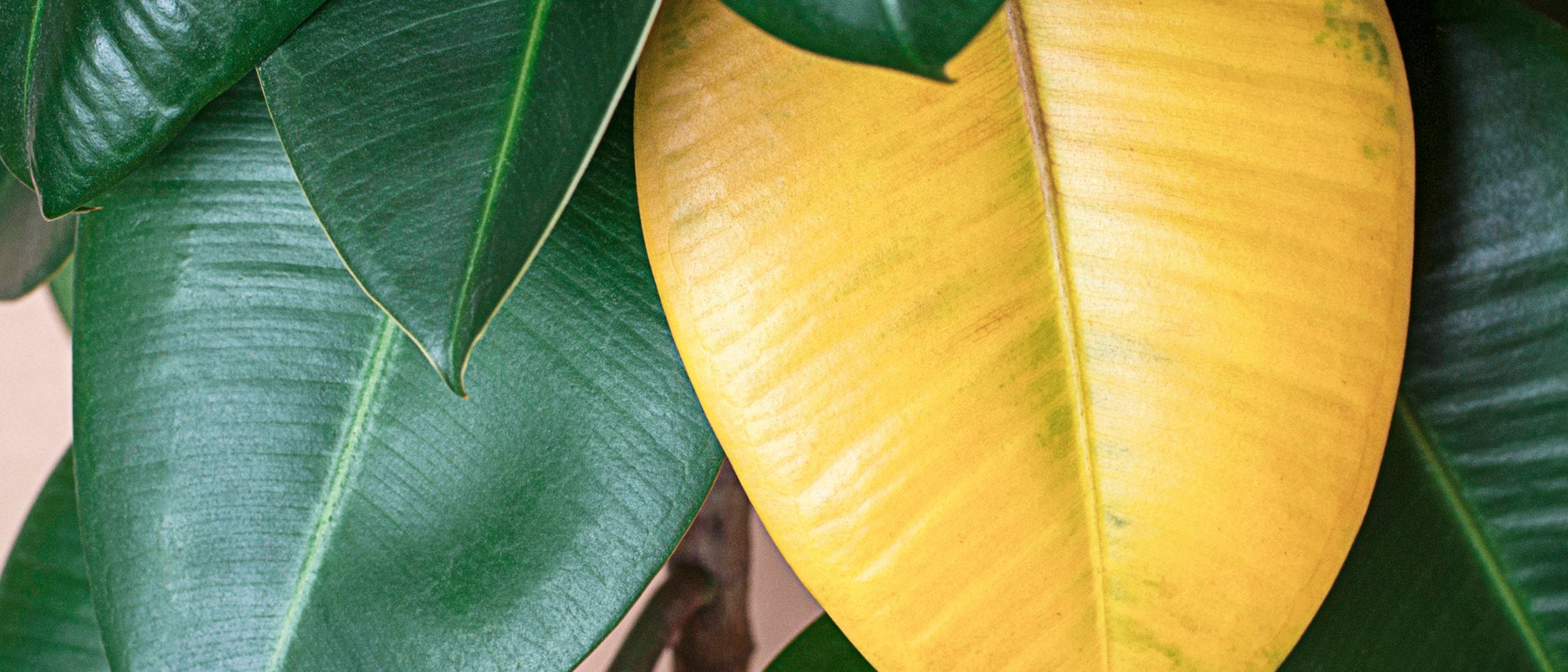
The short answer Yellow leaves are a stress signal, and the first thing to check is water, especially too much of it sitting around the roots. Where the yellow appears narrows it down: an occasional old lower leaf is normal aging, many yellow lower leaves point to watering or a nitrogen shortage, and yellow new leaves with green veins point to iron, which high pH can lock away from the roots.
Yellowing is one of the plainest signals a plant gives, and it carries more information than it seems to. Two questions do most of the work. Which leaves are yellow, the old ones at the bottom or the new ones at the tips? And what does the yellow look like: a solid wash, yellow between green veins, or fine speckles?
Look before you water, feed or move anything. If you change three things at once, you won’t know which one helped.
Match the pattern first
| What you see | Most likely cause | Check first |
|---|---|---|
| One old lower leaf yellows now and then; new growth looks fine | Normal aging | Nothing to fix |
| Many lower and inner leaves yellow, mix stays wet, plant may wilt | Overwatering or poor drainage | Pot weight, roots |
| Lower leaves yellow, mix bone dry, pot feels light | Underwatering | Soak and recheck |
| Older leaves evenly pale yellow, veins included | Nitrogen shortage | Feeding history |
| Older leaves yellow between green veins | Magnesium shortage | Feeding history |
| New leaves yellow between green veins | Iron shortage, which high pH or hard water can cause | Water source, mix pH |
| Yellow or scorched patches on the sunny side | Too much direct sun | Where the sun hits |
| Yellowing after a cold night, a move, or near a drafty door | Cold or temperature shock | Location |
| Fine yellowish speckles, sometimes with webbing | Spider mites | Look closely at leaves and stems |
Step 1: Rule out normal aging
The RHS puts it simply: it is normal for the odd lower leaf on a mature plant to yellow and fall. If a bottom leaf goes yellow every so often while new leaves keep coming in green and firm, the plant is shedding old foliage. Pull the leaf off once it comes away easily.
Yellowing in large numbers is different and has a cause worth finding. One exception: a plant that has just been moved, such as from a patio back indoors, may yellow a few leaves from the stress of the change even when you did everything right, Clemson Extension notes.
Step 2: Check the water and the roots
Start with overwatering. University of Maryland Extension describes wilting or yellowing of the lower and inner leaves as the primary symptom. Excess water cuts the oxygen in the mix, which damages the fine roots, and then the plant can’t take up water. That is why an overwatered plant can wilt in wet soil and look thirsty.
To check:
- Lift the pot right after watering, then again every day or two. You’ll learn what “wet” and “dry” weigh.
- Push a wooden dowel or chopstick to the bottom of the pot. Moist mix will stick to it or darken it.
- If the mix is still wet days after watering, slide the plant out. The RHS says dark, soft or brittle roots mean poor root health, and brown, rotted, soft roots mean the plant has been getting too much water.
Let the mix dry before the next watering. When you do water, water until it runs out the bottom, then pour off what collects in the saucer. If the pot is much bigger than the root ball, the RHS suggests moving the plant into a smaller container, since overpotting is its own cause of yellowing. The full side-by-side of the two water problems is in overwatering vs underwatering.
Underwatering also yellows leaves. The pot feels light and the mix is dry well below the surface. If the mix has shrunk away from the sides of the pot, water it in several rounds until it soaks through. For a routine that avoids both extremes, see how often to water houseplants.
Step 3: Read the veins and the leaf age
If the roots look healthy, think nutrients. The key idea is mobility. A nutrient is mobile if the plant can move it from one part of the plant to another as needed, so when supply runs short, the older leaves give theirs up and show the shortage first. Immobile nutrients can’t be moved, so a shortage shows up first in new growth (University of Delaware Extension).
- Mobile: nitrogen, phosphorus, potassium, magnesium. Look low on the plant.
- Immobile: iron, calcium, manganese, zinc, copper, boron. Look at the tips.
UMass Extension’s diagnostic key describes the patterns:
- Nitrogen: even, uniform yellowing of the lower leaves.
- Magnesium: yellowing between the veins of the lower leaves, with the veins staying green.
- Iron: yellowing between the veins of the newest leaves at the top.
For nitrogen, check when you last fed the plant during its growing season. If it’s been months, use a balanced houseplant fertilizer at the label rate. More is not better: Delaware Extension recommends testing before adding fertilizer, and the RHS warns that over-feeding with potassium-rich fertilizer can bring on magnesium deficiency.
Step 4: Suspect pH when new growth yellows
Yellow new leaves with green veins don’t necessarily mean the pot lacks iron. The plant may simply be unable to get at it. Iron, manganese, zinc and boron exist in forms plants can’t use at alkaline pH (Delaware Extension). In a pot, one route there is the water you use: the RHS notes that prolonged watering with hard tap water can leave iron, magnesium or manganese unavailable, and that lime-hating plants are especially prone.
Test the mix’s pH before treating. If it’s high and the plant prefers acidic conditions, the RHS suggests repotting into an acidic mix (ericaceous compost, in British terms), watering with rainwater brought to room temperature, and using a foliar feed.
Step 5: Check light and temperature
Light can push leaves yellow in both directions. The RHS lists too shady a position as a cause and suggests brighter spots in winter, when light levels drop. It also notes that too much midday sun can make leaves droop or scorch yellow. If the damage is on leaves facing the glass, that’s your clue. For how to measure what a spot actually gets, see how much light houseplants need.
Cold is another trigger. The RHS names too cold a temperature, a sudden drop and draughts, particularly in winter. Clemson Extension notes that several tropical species can suffer chill injury at or below 50°F. Think about a windowsill on a winter night, a spot by an exterior door, or a plant that rode home in a cold car. Move it somewhere steady and watch the new growth.
Step 6: Look for pests
Spider mites yellow leaves too, but the damage starts as speckling rather than a clean pattern. Iowa State Extension describes light infestations as foliage speckled with very tiny yellowish-green spots. Heavy infestations turn leaves greenish yellow and eventually tan or brown, and you may see very fine webbing on leaves and stems.
For a small infestation, take the plant to the shower and use a forceful spray of water to knock the mites off. Iowa State says a heavily infested plant is usually best discarded. If you use a miticide, choose one labeled for houseplants and follow the label. The RHS also lists aphids, mealybugs, scale insects and whitefly among the pests that discolor houseplant leaves, so check stems and leaf joints while you’re looking.
After you’ve made a change
Change one thing, write down what and when, and judge the result by the leaves that come in next rather than the ones already yellow. If new growth is green and firm after a few weeks, you found it. If not, go back to the table and work down the next likely cause.
Sources
- Leaf damage on houseplantsRoyal Horticultural Society (RHS)
- Overwatered Indoor PlantsUniversity of Maryland Extension
- Identifying Nutrient Deficiencies in Ornamental PlantsUniversity of Delaware Cooperative Extension
- Plant Nutrition for Greenhouse Crops: Key to Identifying Nutrient Disorders of Greenhouse CropsUMass Extension
- How do I control spider mites on houseplants?Iowa State University Extension and Outreach
- Prepare Houseplants to Move Back InsideClemson Cooperative Extension, Home & Garden Information Center
General information, not professional advice for a specific plant or crop. Spot something wrong? Email info@terrathink.io.


